
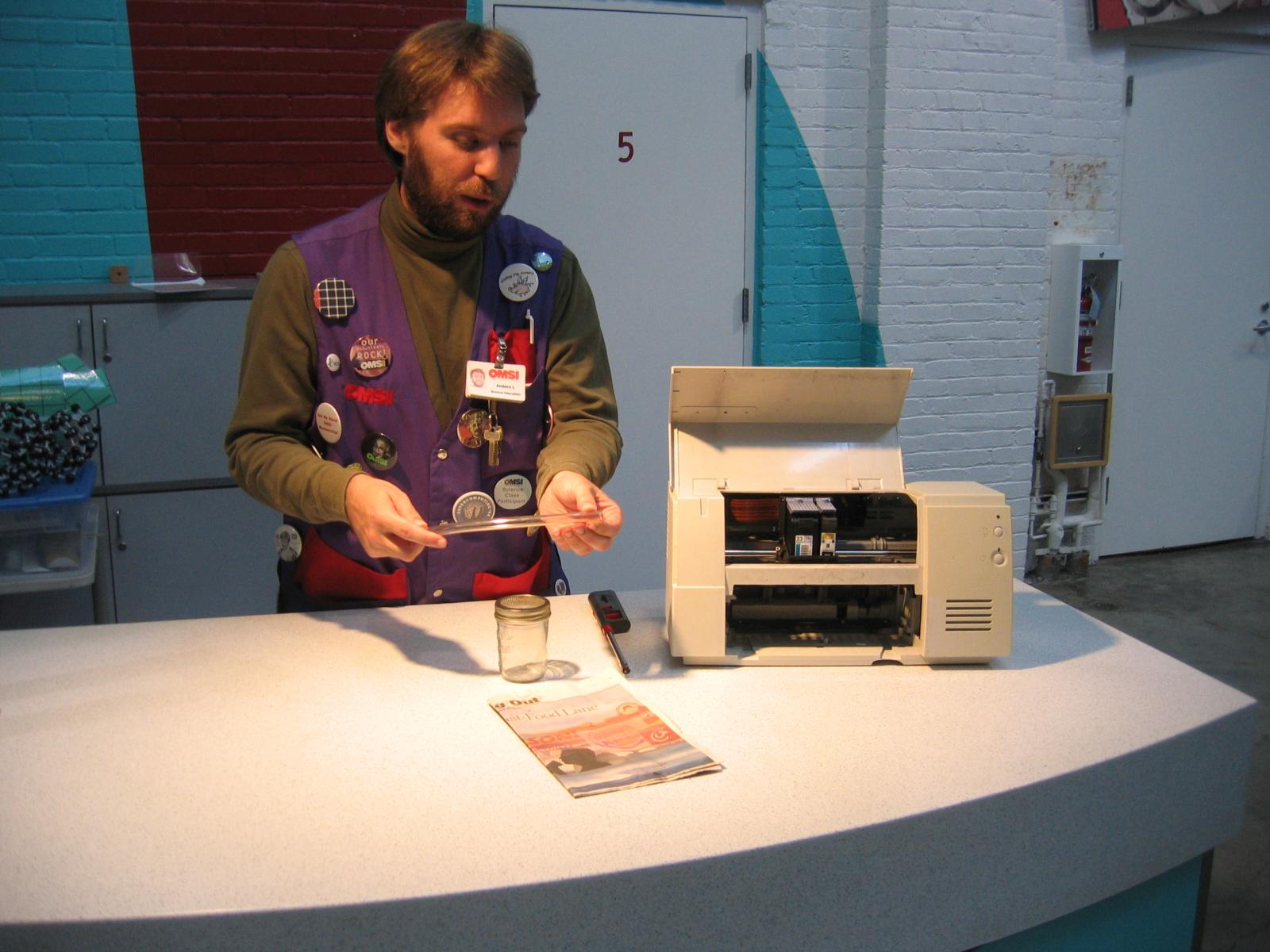
Through hands-on activities, visitors learn how inkjet printers produce tiny, precise drops of ink. They examine printed paper with magnifying glasses, see a few demonstrations of how liquids behave differently at the small scale, and see an explosive demonstration of how ink is forced out of an ink cartridge.
We found that holding your thumb or finger over the uninked end of the capillary tube while you heat the other end helps a great deal in preventing the ink from flying out the wrong end of the tube. You'll get a tiny dot of food coloring on your finger, but it won't spray all over everything else.
We purchased the Xyron Design Runner handheld printer (http://www.xyron.com/enUS/Products/Xyron_Design_Runner.html) for this program. The machine itself looks nice, but the quality of the printing is pretty poor. However, this is actually better for the program's purposes because it makes it easier to see the dots and lines that make up the images. The 40 image/text options that come with the printer are mainly cheesy scrapbooking things, and it can take awhile to scroll through the choices to find one appropriate for our purposes (we settled on image 25 - a fish), because the machine doesn't remember which image you used last. Overall, it's a pretty expensive, but since there doesn't seem to be another option, I think the handheld printer adds a lot to the program if you can afford it.
Submitted by Uzelmeier on Tue, 09/16/2008 - 19:20.
New Kodak "All-in-One inkjets boast "nano-particle" inks that make the ink stay vibrant times 7 longer and cost half as much. I'm guessing the 1/2 as much is because they use smaller amounts of ink per squirt. Any guess on the more vibrant part?
Calvin Uzelmeier
Rochester Museum & Science Center
Submitted by jchilders on Sat, 09/13/2008 - 11:59.
Those of you at Ithaca recently will recall how we wondered what the dimensions of a picoliter drop in nanometers might be. Well, Google Calculator to the rescue! It turns out a spherical picoliter drop has a diameter of about 12,400 nm (vs. 50,000 quoted above). An attoliter is 124nm across and a zeptoliter is 12.4nm across, so you need to go a millionth or billionth of a picoliter before you get to nano scales.
“Programs” are public interactions facilitated in-person by museum professionals. Here you’ll find all the materials you need to host many kinds of programs, including large lectures, small floor demonstrations, comedy and theater pieces, and quiz and game shows.
NISE Net includes some of the premier science program developers in the United States—people with years of experience in creating engaging experiences around complex scientific concepts. The programs offered here were vetted through a process of prototyping, audience research, and in-depth partnerships with scientists.
4 Comments
Cutting down on mess
We found that holding your thumb or finger over the uninked end of the capillary tube while you heat the other end helps a great deal in preventing the ink from flying out the wrong end of the tube. You'll get a tiny dot of food coloring on your finger, but it won't spray all over everything else.
We purchased the Xyron
We purchased the Xyron Design Runner handheld printer (http://www.xyron.com/enUS/Products/Xyron_Design_Runner.html) for this program. The machine itself looks nice, but the quality of the printing is pretty poor. However, this is actually better for the program's purposes because it makes it easier to see the dots and lines that make up the images. The 40 image/text options that come with the printer are mainly cheesy scrapbooking things, and it can take awhile to scroll through the choices to find one appropriate for our purposes (we settled on image 25 - a fish), because the machine doesn't remember which image you used last. Overall, it's a pretty expensive, but since there doesn't seem to be another option, I think the handheld printer adds a lot to the program if you can afford it.
New Kodak "All-in-One
New Kodak "All-in-One inkjets boast "nano-particle" inks that make the ink stay vibrant times 7 longer and cost half as much. I'm guessing the 1/2 as much is because they use smaller amounts of ink per squirt. Any guess on the more vibrant part?
Calvin Uzelmeier
Rochester Museum & Science Center
Those of you at Ithaca
Those of you at Ithaca recently will recall how we wondered what the dimensions of a picoliter drop in nanometers might be. Well, Google Calculator to the rescue! It turns out a spherical picoliter drop has a diameter of about 12,400 nm (vs. 50,000 quoted above). An attoliter is 124nm across and a zeptoliter is 12.4nm across, so you need to go a millionth or billionth of a picoliter before you get to nano scales.