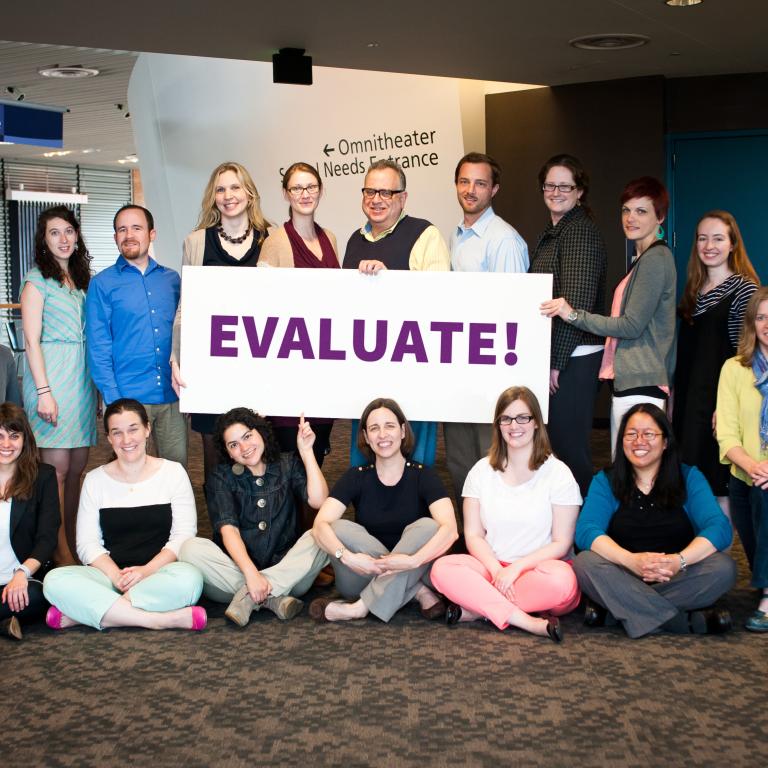
The NISE Network Evaluation group is a multi-organizational group dedicated to informing and improving the work of the Network by conducting evaluation studies that closely examine the public, professional, and field-wide impacts of NISE Net activities. Group members have worked closely with nearly all NISE Net groups and teams, including Viz Lab, Forums, Exhibits and Programs, Network Community, the Network Executive Group, amongst others. In each area, evaluators work with the Network teams, conducting studies for those teams that encourage professional inquiry and provide constructive feedback.
Evaluation Tools
-
The NISE Network program evaluation tools package includes guidelines and templates to facilitate in program evaluation.
-
Team Based Inquiry is an approach to formative evaluation. Team Based Inquiry (TBI) involves asking questions related to your work or practice, collecting data to answer those questions, analyzing and reflecting on the data, and identifying concrete ways to improve based on findings. At its core,Team Based Inquiry is about building our capacity to gather and use the information we need, when we need it, in order to improve our educational products and practices. Team Based Inquiry can inform the development of new programs or exhibits, the modification or adaptation of programs to different audiences or different contexts, the development or improvement of staff training programs, or the ongoing improvement of staff facilitation strategies.
Examples of Evaluation Studies
A complete listing and access to all NISE Net evaluation reports is available through the Research & Evaluation section of the catalog: http://www.nisenet.org/catalog/eval
Examples of the kinds of studies conducted by the NISE Net Evaluation group include the following:
- A literature review that summarized findings from secondary sources that describe public awareness, interest, knowledge and attitudes related to nanotechnology (2005). Nanotechnology and the Public -Front End Report Part 1A (PDF, 477 MB) and Appendices - Front End Report Part 1B (PDF, 442 MB)
- A literature review of existing Nanoscale Communication Projects (2005). Front End Report Part 2A (PDF, 9.3 MB) and Appendices - Front End Report Part 2B (PDF, 3.3 MB) Appendices
- A formative evaluation that looked at ways to improve visitor enjoyment, engagement and perceived learning of a discussion forum that was held at five institutions Risks, Benefits, and Who Decides? report
- A formative evaluation that explored the effectiveness of an initial set of NISE Net prototype exhibits in 2006
- A formative evaluation that was designed to improve the NISE Net regional workshops and ensure they were beneficial networking and professional development opportunities for NISE Net partners. 2008 Program Workshop report
- A formative evaluation that gathered information to increase visitor interest, enjoyment, and understanding of the Nano Days kit Buckyball activity. Exploring Structures - Buckyballs report
- An interview-based study that investigated how museum visitors interpreted scale ladders that focus on the nanoscale Scale Ladders report
- An evaluation that studied the effect of the Nanoscale Education Outreach program on the participants’ professional capacities and future involvement in the NISE Network NEO Workshop report
- A summative evaluation study that examined the growth and development of the Network Overview of the NISE Network Evaluation report
Network-Wide Evaluation
The NISE Network Evaluation Team has conducted several studies investigating issues related to public and professional impacts across the Network.
- Year 5 Summative Evaluation of Exhibits and Programs studies the impact of a set of NISE Net exhibits and programs on museum visitors.
- The 2010 Delivery and Reach Study examines nano educational activities that NISE Net partners are doing and estimates the public reach of the Network.
-
Review of NISE Network Evaluation Findings: Years 1-5 is a review of the findings from over 240 evaluation reports from the first five years of the Network. The review is divided into six chapters:
- A Study of Communication in the NISE Network (Network Communication Study) (2012) to learn about how the Network's primary communication components, NanoDays, face-to-face meetings, the regional hub structure, and the nisenet.org website, are being used by actively involved partners.
Who we are
During the project, the evaluation team has included staff members from the following organizations:
- Museum of Science, Boston
- Science Museum of Minnesota
- Oregon Museum of Science and Industry
- Exploratorium
- Inverness Research Associates
- Multimedia Research
In addition, the public impacts summative evaluation is overseen by an external Committee of Visitors comprised of the following members:
- Bruce Lewenstein
- Saul Rockman
- Frances Lawrenz
- Carol Weiss
NISE Network's online surveys are powered by SurveyGizmo.