
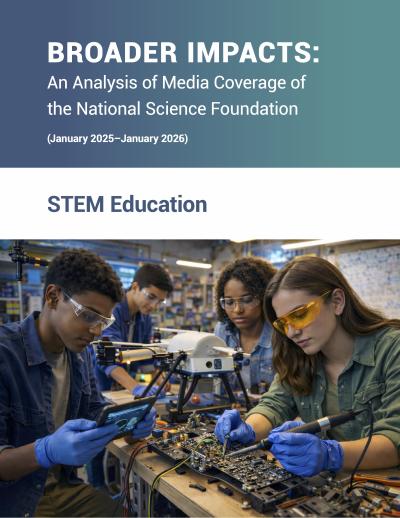
A newly released report from the Study Group examines broader impacts and media coverage of the National Science Foundation (NSF) 75th anniversary from January 2025-January 2026.
The report series is divided into broader Impacts dimensions:
- Economic Competitiveness and Innovation
- National Security
- STEM Education
- Workforce Development
- Societal Well-being
- Research Infrastructure
The STEM Education report includes a focus on the National Science Foundation’s investments in informal science.
“By supporting STEM education efforts outside of formal classrooms, NSF has woven STEM into the fabric of daily life, making discovery accessible to families regardless of their background or location, and equipping them with knowledge to make decisions about their own lives and communities."
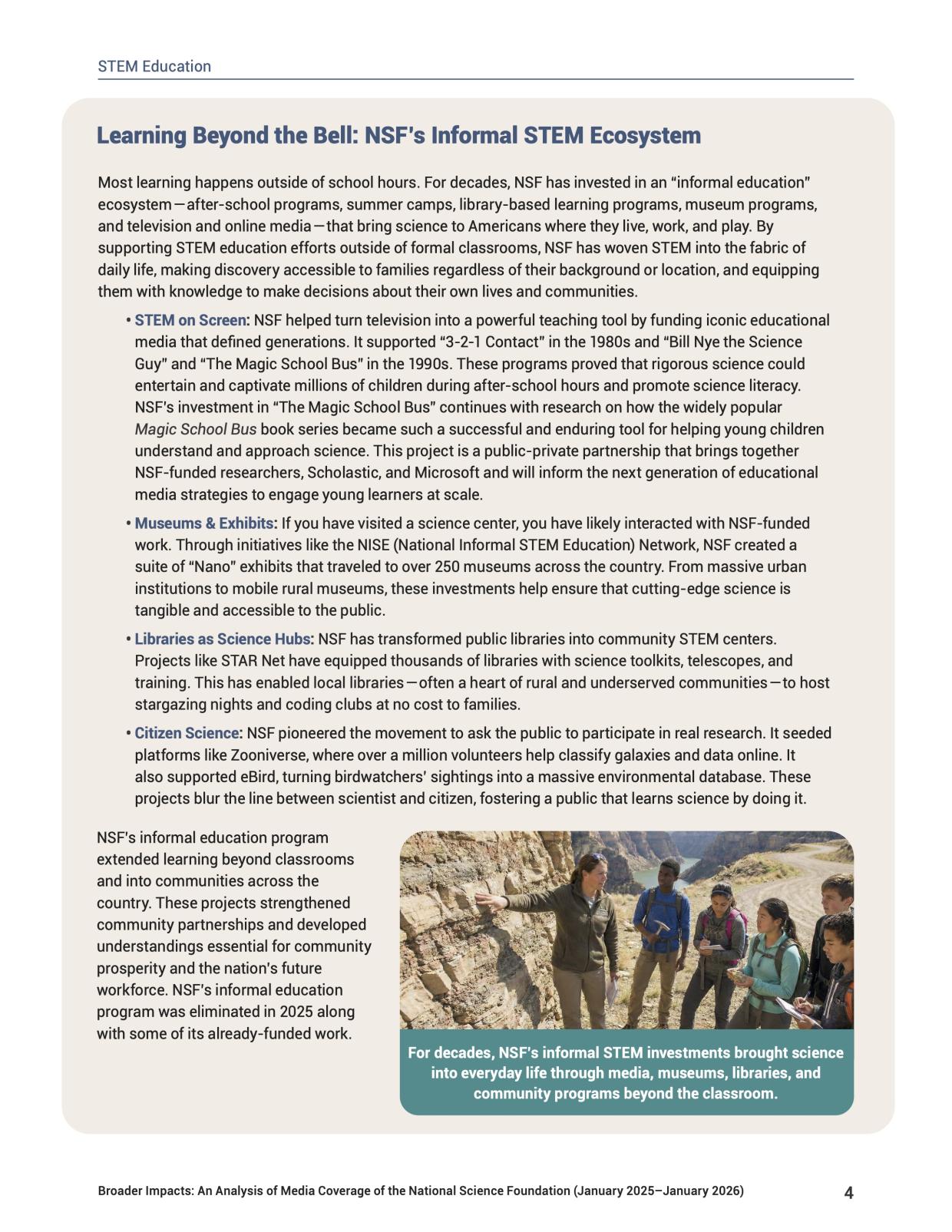
For decades, NSF’s informal STEM investments brought science into everyday life through media, museums, libraries, and community programs beyond the classroom.
Special call-outs in the report included public television, the NISE Network, STAR Net library network, and citizen science programs.
The report concludes,
“For 75 years, the NSF has led federal investments in STEM education, a mission this analysis of 3,800 articles confirms is essential to U.S. competitiveness. Coverage highlights that a robust educational infrastructure — spanning K–12 curricula, informal learning in libraries, and targeted support for rural America — relies on the Directorate for STEM Education (EDU) to drive evidence-based practices and increasingly vital AI literacy. Media reports warn, however, that scaling back these programs threatens to erode the pipeline of future talent needed for advanced manufacturing and data-driven careers. Ultimately, the coverage suggests America faces a stark choice: decisively invest in the STEM education that powers our future, or risk falling behind in an increasingly technical world."