
MARCH 2026
NETWORK NEWS
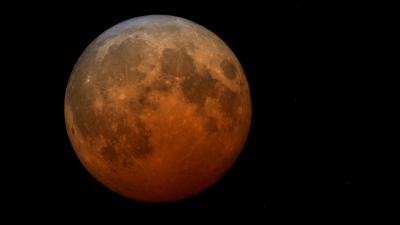
Lunar Eclipse (March 2-3, 2026)
The lunar eclipse will be visible throughout North America if the sky is clear.
Timing
Tuesday, March 3, 2026 early morning
• Partial eclipse begins: 3:44am Eastern = 12:44am Pacific
• Total eclipse begins: 6:04am Eastern = 3:04am Pacific
• Maximum: 6:33am Eastern = 3:33am Pacific
• Check for exact timing for your location at
https://www.timeanddate.com/eclipse/
Viewing tip: Since the Moon will be close to the horizon at maxium, we recommend going to a high point or finding an unobstructed area with free sight to the West for the best view of the lunar eclipse.
During a lunar eclipse, the Earth blocks most of the sunlight that normally reaches the Moon. The Earth is between the Sun and the Moon. The total lunar eclipse is sometimes called a blood moon, as the Moon turns red in color.
Lunar eclipse resources
nisenet.org/lunareclipse
UPCOMING CONFERENCES
If you are attending these conferences, please be sure to connect with NISE Network staff and projects.
Association of Children's Museums InterActivity Conference 2026 this April in San Diego
nisenet.org/ACM2026
American Alliance of Museums - 2026 AAM Annual Meeting this May in Philadelphia, PA
nisenet.org/AAM2026
UPCOMING EVENTS
Online Workshops
The NISE Network hosts free online workshops as professional development opportunities for our partners to share with and learn from each other. Online workshops take place on select Tuesdays at 2pm-3pm Eastern. View upcoming online workshops at nisenet.org/events
• Museums Share Experiences Participating in STEM Learning Ecosystems
Tuesday, March 31, 2026
2-3pm Eastern
Learn more and register
• Finding and Collaborating with NASA Experts - Solar System Ambassadors and Night Sky Network
Tuesday, April 14, 2026
2-3pm Eastern
Learn more and register
• Library Collaborations to Engage Local Public Audiences
Tuesday, May 19, 2026
2-3pm Eastern
Learn more and register
FEATURED ON THE WEBSITE

Professional Learning Resources:
Talking with Children about Tragic Events in the News
Parents, caregivers, and educators can all play an important role in helping children recover from exposure to tragic events in the news as well as traumatic experiences. Navigating these conversations isn't easy, but these resources can be helpful for both children and adults.
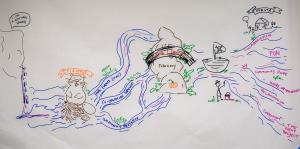
Reflecting on Your Partnership Journey
Based on the “River of Life,” this participatory activity can be used with a group of partners. Together, the group creates a drawing that represents their collaboration as a journey down a river.
More collaboration and co-creation resources
Recent Publications:
• Uniting Under the Eclipse: A Mega-Collaboration to Activate Science Learning Across the Penumbra and Beyond has been published in the Bulletin of the American Astronomical Society (BAAS). The paper describes how NASA's Science Activation (SciAct) program collaborated to reach learners across the nation during the 2023-24 solar eclipses.
Learn more
More publications:
nisenet.org/publications
Online Workshop Recordings:
• Young People Co-creating STEM Engagement Projects
(recorded 2-3-26)
Learn more
• How to Be a Part of 2.50 Million Acts of Science with SciStarter
(recorded 1-13-26)
Learn more
• More online workshop recordings
Navigating Changing Federal Priorities:
Resources to help your organization navigate changing federal priorities for STEM, public engagement, and education.
Learn more
United States 250th “Semiquincentennial”
Resources to help plan relevant programming for the United States' 250th anniversary (Semiquincentennial)
nisenet.org/america250
Looking for an easy way to discover resources on the nisenet.org website?
Check out our “Browse by Themes and Topics,” featuring curated collections of hands-on activities and resources by themes and STEM topics:
nisenet.org/browse-topic
PARTNER HIGHLIGHT
Space Fest 2026 at the
Bell Museum, University of Minnesota
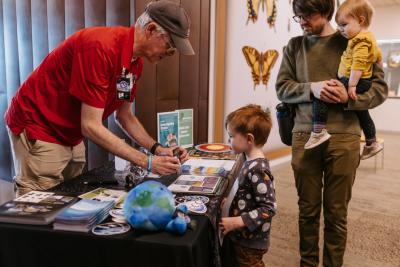
The Bell Museum hosted Space Fest: Love Letter to Earth, February 13-15, 2026 - an Earth and space science celebration. Visitors were invited to take a look at what makes Earth so special, and how we can be good stewards of our planet. Throughout the weekend, there were hosted talks, hands-on activities, scientists, researchers, and an astronaut at the museum! Other highlights from the weekend included tabling events with Solar System Ambassadors, planetarium shows, and lots of NISE Network Earth & Space activities.
Learn more
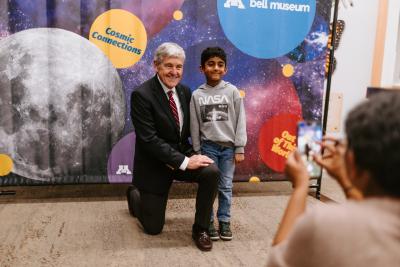
Photo Credit: Bell Museum
COMMUNITY RESOURCES AND ANNOUNCEMENTS
America250: Celebrating American Innovation
Poster Exhibition, Planetarium Show, and Resource Guide
The Phillip and Patricia Frost Museum of Science (Frost Science) is celebrating the American spirit of creativity and discovery through championing 250 American scientists, innovators, and engineers across the fields of marine science, paleontology, human health, astronomy, and aeronautics and flight. The Frost is offering the following resources to institutions interested in celebrating innovation: poster exhibition, short planetarium show, resource guide highlighting 250 American scientists, innovators, and engineers, and a lesson plan for grades 9-12.
• Fill out this interest form to receive resources in early May
• Learn more

Moments That Made US
Customizable Exhibition Panels
As part of the commemoration of America’s 250th, Moments That Made US is a free, customizable, print-on-demand exhibition exploring defining moments in U.S. history. Developed as an exhibition at the History Colorado Center and adapted for sharing through a multi-state collaboration, the exhibition will feature 21 modular, ready-to-use panels with the option to add local content. Materials are free to download so the only cost is printing and mounting in your space.
• Fill out the interest form
• Download the user guide

National Academies Proceedings Now Available
The National Acdemies has released “The Status of Informal Science and Engineering Education: Proceedings of a Convocation 2026,” which summarizes the proceedings of a meeting bringing together more than 400 researchers, practitioners, policymakers, and funders to discuss the latest developments in the field of informal science and engineering education.
Learn more
Rural Place-Based Learning Opportunity
Desert Dialogues is an 18-month hybrid program for rural museum teams in the West (CA, ID, MT, NV, OR, UT, WA, or WY) who want to reimagine their work through collaborative, community-centered practice. The High Desert Museum invites teams of 2–3 people to join monthly virtual sessions, two multi-day workshops in Bend, Oregon, and hands-on support to design and implement a program in their own community. Travel expenses are covered and a $2,500 stipend is provided. Applications are due March 31.
Learn more
Citizen Science Month
During April and in celebration of America’s 250th birthday in 2026, SciStarter will rally thousands of volunteers worldwide to complete 2.50 Million Acts of Science. SciStarter is looking for libraries and museums to host events.
Learn more
STEM Learning Journeys Opportunity
In partnership with Verizon™, STEM Next has launched a new set of free resources designed for afterschool programs. Programs that complete one of the Learning Journeys focused on Nature & Sustainability can also qualify for a stipend of up to $1,500, based on youth participation
Learn more
Tactile Panels of Uranus
The Space Telescope Science Institute (STScI) is offering tactile panels (12" x 12") of the first images of Uranus by the James Webb Space Telescope at no cost to museums, science centers, libraries, and other sites of informal learning in the United States.
Learn more
SCIENCE IN THE NEWS
NEUROSCIENCE NEWS
Ever struggled to remember a new face after a rough night’s sleep? A new study reveals that chronic sleep disruption impairs social memory by crippling oxytocin signaling in two specific brain circuits.
Learn more
NISE Network resources:
• Brain and neuroscience resources
GENETICS NEWS
Would you want to know your child’s DNA? When a baby is born, their blood is tested for serious, treatable diseases. But if you could screen your healthy baby for hundreds more rare genetic risks — which may or may not ever develop into disease — would you?
Learn more
NISE Network resources:
HEALTH NEWS
Researchers have confirmed that an increase in adoption of electric vehicles has led to reductions in air pollution.
Learn more
NISE Network resources:
• Air quality resources
• Health resources
SPACE NEWS
Due to a helium leak, the Artemis II mission to send astronauts around the Moon will not launch until April 2026 at the earliest.
Learn more
NISE Network resources:
ENGINEERING NEWS
Researchers have built a swarm of interconnected mini-robots that bloom like flowers in response to changing light levels - these unfolding robots could be used for “living architecture” to adjust to weather and light conditions.
Learn more
NISE Network resources:
• Engineering and robot resources
• Exploring the Universe: Pack a Space Telescope
BIOMIMICRY NEWS
Elephants use their trunks much like a human uses their hands: to pick up food and manipulate objects. A new study finds that tiny, specialized whiskers on elephant trunks help them do it. Understanding of touch can be useful for making new mechanical tools or robots.
Learn more
NISE Network resources:
• Biomimicry resources
• Senses resources
• Engineering and robot resources
NANOTECHNOLOGY NEWS
Scientists have found that microplastics ingested by crabs are ground into even smaller fragments. These nanoplastics in the crab’s tissues can then enter the food chain. The research underscores growing concerns about how ultra-small plastic particles move through marine ecosystems and into foods people rely on.
Learn more
NISE Network resources:
• NISE Network water resources
• NanoDays activities
• NISE Network Size, Scale, & Measurement resources
CLIMATE AND WEATHER NEWS
Global Warming’s Six Americas ongoing study examines six distinct audiences within the American public (Alarmed, Concerned, Cautious, Disengaged, Doubtful, and Dismissive). New data shows that over the past ten years, the Alarmed group has grown more than any other audience, from 11% in 2015 to 25% in 2025 (a 14% increase).
Learn more
NISE Network resources:
STEM THROUGHOUT THE YEAR
Discover activity ideas for incorporating current science, engineering, and technology content into events, special programming, holidays, and seasonal activities by visiting: nisenet.org/seasons
Year-long 2026
Winter
- NISE Network Snowflakes: Nano at its Coolest program
- NISE Network Exploring Fabrication - Self-Assembly program
- NISE Network water resources including ice and snow
MARCH
- What’s Up Skywatching Tips from NASA
- Women's History Month (March)
- Worldwide Climate Justice Education Month (March)
- Severe Weather Awareness Weeks (March, dates vary by state)
- World Futures Day - Young Voices (March 1)
- Lunar Eclipse (March 2-3, 2026
- The lunar eclipse will be visible throughout North America if the sky is clear. Check for exact timing for your location at https://www.timeanddate.com/eclipse/
- NISE Network Lunar eclipse resources
- Dr. Seuss Day (March 2)
- Exploring Materials - Oobleck activity
- Oobleck gets its name from the Dr. Seuss book Bartholomew and the Oobleck where a gooey green substance, Oobleck, fell from the sky and wreaked havoc in the kingdom
- Horton Senses Something Small activity
- Horton Hears a Who! Storytime activity
- NISE Network books, reading, and storytelling
- World Wildlife Day (March 3)
- World Engineering Day for Sustainable Development (March 4)
- Groundwater Awareness Week (March 8-14, 2026)
- Brain Awareness Week (March 16-22, 2026)
- International Day of Mathematics (March 14)
- Pi Day (March 14)
- Pi Day is celebrated on March 14 (3-14) to commemorate the mathematical constant π (pi). Pi is the ratio of a circle's circumference to its diameter, and is approximately 3.14159.
- NASA Pi Day Challenge
- NASA 10 ways to Celebrate Pi Day
- NISE Network size, scale, & measurement resources
- Howtosmile.org Pi activities
- National Learn about Butterflies Day (March 14)
- Spring Equinox (March 20 in the Northern Hemisphere)
- Solstices and equinoxes provide opportunities for planning quarterly programs related to the Earth, Sun, and Moon (astronomical seasons) or your local environment (meteorological seasons)
- NASA Space Place seasons resources
- NISE Network Moon resources
- World Water Day (March 22)
- World Meteorology Day (March 23)
- National Ag Day (March 24, 2026)
- National AI Literacy Day (March 27, 2026)
- Earth Hour (March 28, 2026)
- NanoDays (March 28-April 5, 2026)
APRIL
- Citizen Science Month (April)
- National Kite Month (April)
- National Poetry Month (April)
- Global Astronomy Month (April)
- Mathematics and Statistics Awareness Month
- National Arab American Heritage Month (April)
- Star Trek First Contact Day (April 5)
- National Robotics Week / RoboWeek (April 4-12, 2026)
- National Public Health Week (first full week in April) / World Health Day (April 7)
- Yuri's Night (April 12)
- International Dark Sky Week (April 13-20, 2026)
- World Quantum Day (April 14)
- World Art Day (April 15)
- World Creativity and Innovation Day (April 21)
- Earth Day (April 22)
- DNA Day (April 25)
- Arbor Day (last Friday in April)
NATIONAL MEETINGS AND CONFERENCES
- ASTC List of Conferences in the Community
Learn more - Association of Children's Museums (ACM) InterActivity, April 21-23, 2026, San Diego, CA
Learn more - American Alliance of Museums 2026 AAM Annual Meeting May 20-23, 2026, Philadelphia, PA
Learn more - Science Events Summit, May 31 - June 2, 2026 Jackson, MS
Learn more - National Rural STEM Summit, August 26-29, 2026, Fort McDowell, AZ
Learn more - ASTC Conference, September 16-19, 2026, Phoenix, AZ
Learn more - National Science Teaching Association (NSTA) Conferences
Learn more